Lab-on-chip MFC · engineering redesign dossier · July 2026
Device redesign · review → fix → render
A fuel cell on a chip, taken apart and made honest.
The homepage's lab-on-chip render, put through an engineering review and rebuilt so it survives a bioelectrochemist's read — three blocker-level fixes, an honest reaction, and the volume restored — without leaving the aesthetic. The exploded stack below is the real layer set.
Exactly what ships on the apps/site homepage — the real R3F stage, rendered headless. Everything below is a static breakdown of the same device, so you can inspect it without deploying.
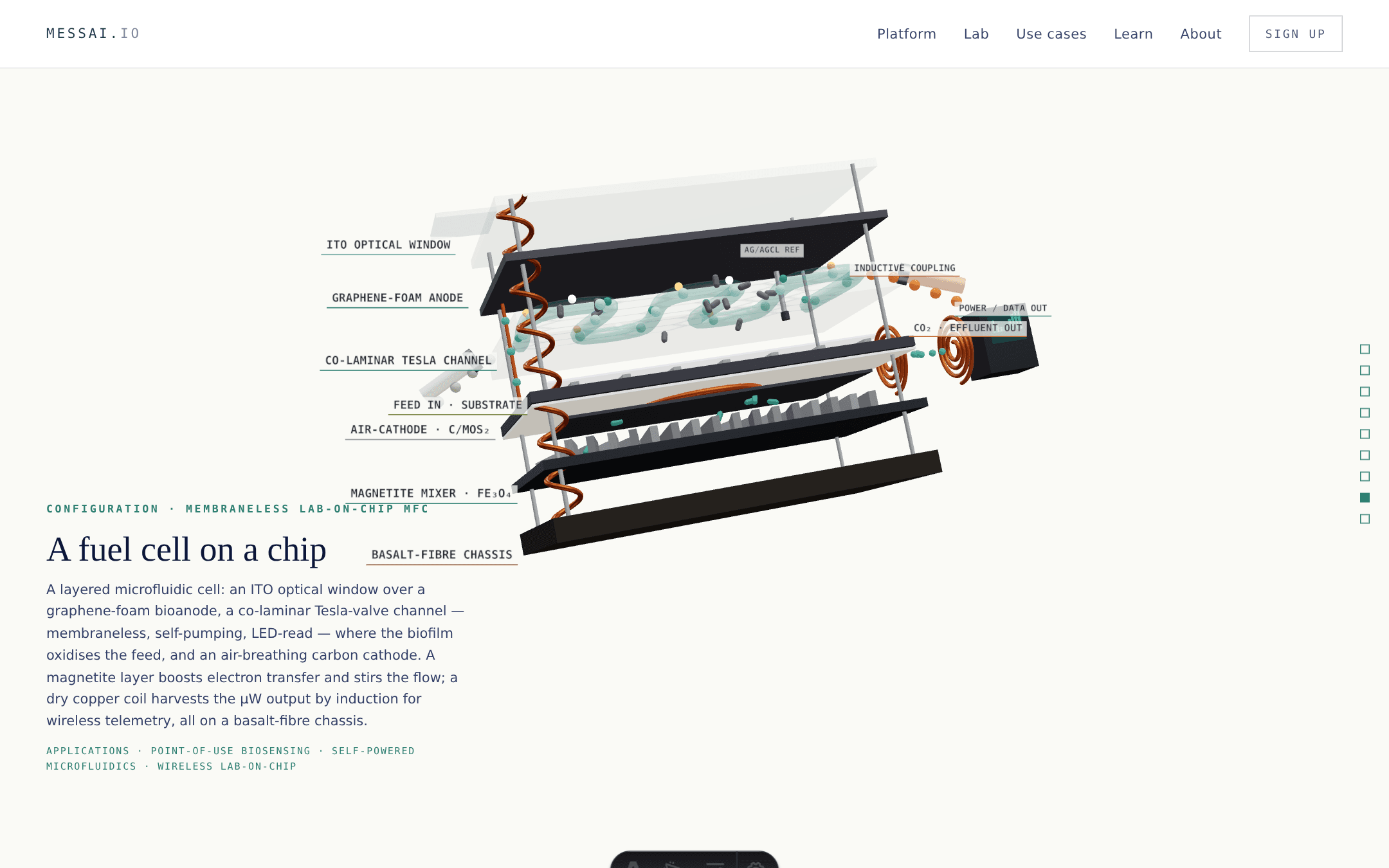
Each film is drawn from the device's real material set. The table reads top film (L1) to chassis (L6); the PEM is the optional separator between L3 and L4 and is absent in the membraneless hero mode.
| Layer | Component | Material | Feature | Role | Why |
|---|---|---|---|---|---|
| L1 / 6 · top film | ITO optical window | ITO (In₂O₃:Sn) | Transparent conductor · optical access | Window · current path · readout | A transparent conductive-oxide lid that closes the cell, carries current, and lets light in for microscopy and optical readout — the credible read of the old "perovskite" cover. |
| L2 / 6 · conductor | Graphene-foam bioanode | Graphene foam · rGO | Honeycomb lattice · biofilm scaffold | Bioanode current collector | A 3-D graphene-foam / rGO sheet is the current-collecting skin the electroactive biofilm grows on — huge conductive surface area, unlike hydrophobic flat graphene. |
| L3 / 6 · bioreactor | Co-laminar Tesla channel | Biofilm · agar · PDMS channel | Membraneless co-laminar · Tesla self-pump · LED readout | Biocatalysis · rectification · sensing | The living heart, run membraneless: two co-flowing streams stay split by laminar flow, a Tesla valve rectifies evolved gas into net self-pumping, and LEDs read the cell out optically. |
| optional · between L3–L4 | Composite PEM (optional) | Composite PEM (Nafion-class) | Toggleable · proton transport | Optional separation | Drop this proton-exchange membrane in to run a separated cell; leave it out to run membraneless on the co-laminar streams. That toggle is what makes the slide multi-use. |
| L4 / 6 · electrode | Air-breathing carbon cathode | Carbon · MoS₂ · stainless · PTFE | ORR · metallic collector · dry Cu coil | Oxygen reduction · current path | An air-breathing carbon cathode does oxygen reduction; a stainless current-collector (fingers + bus bar) is the metallic current path, and a DRY copper coil sits beneath for induction. No wetted copper — Cu is antimicrobial and corrodes. |
| L5 / 6 · transport | Magnetite (Fe₃O₄) mixer | Magnetite (Fe₃O₄) · soft-magnetic ridges | Herringbone micromixer · EET boost | Mass transport · electron transfer | A magnetite layer boosts extracellular electron transfer and carries a staggered-herringbone micromixer that folds the co-laminar feed to beat diffusion limits. Replaces the non-physical "magnetic heat sink". |
| L6 / 6 · chassis | Basalt-fibre chassis | Basalt-fibre composite · ferrite | Sustainable substrate · ferrite flux return | Chassis · magnetic return · takeout | A basalt-fibre composite is the inert, cheap, sustainable structural base; a thin ferrite tile gives the pickup coil a real magnetic return, and edge pads take current off-chip. |
The original looked great but conflated three operating modes and carried two hard materials errors. Each was fixed through geometry, not by dropping the aesthetic.
Bare copper in a wetted cell is antimicrobial and corrodes, leaching Cu²⁺ that poisons the biofilm. Copper is now only the dry, encapsulated pickup coil — the wetted cathode is air-breathing carbon.
A µW chip near ambient has no heat load, and magnetism ≠ cooling. Repurposed to a real function: an Fe₃O₄ layer that boosts electron transfer and hosts a staggered-herringbone mixer.
“Magnetic basalt” isn't a real functional material. Kept as a sustainable structural substrate (basalt-fibre composite); the magnetic return path is a proper ferrite backing.
An MFC emits CO₂ from anodic oxidation — it isn't CO₂-fed (that would be electrosynthesis, which consumes power). The feed is now organic substrate; CO₂ + effluent leave.
A halide-PV perovskite is lead-bearing and decomposes in hours in a wet, salty, biological cell. Reframed as the transparent conductive-oxide window it credibly is.
Pristine 2D graphene barely colonises; the real performer is 3D foam/aerogel. And MoS₂/TMDs are cathode catalysts — they moved to L4, where they belong.
The first rigor pass flattened the mid-stack — the bright copper slab became matte carbon, tall fins became short studs. Volume was restored through rigorous geometry, not by reverting.
Where the dimensionality lives now
- Staggered-herringbone micromixer — the canonical passive µmixer: metallic chevrons whose handedness flips every few cells. Strong relief and shadow, and more novel than the fins it replaced.
- Stainless current-collector — fingers + bus bar across the carbon cathode: metallic, light-catching, the real current path — no wetted copper.
- Thicker slabs — anode, cathode, magnetite and chassis given more body so the exploded stack reads chunky again.
Added for credibility
- Ag/AgCl reference electrode — on-chip, for 3-electrode operation: resolves anode and cathode potentials independently. Its absence is a tell that a design isn't real electrochemistry.
- Membraneless co-laminar — foregrounded as the hero mode (two co-flowing streams, no membrane); the PEM is the optional separator, drawn dashed in the stack above.
Defensible upgrades if the stage is ever expanded, recorded in the repo's design-rationale doc.
- Interdigitated microelectrode array — generation/collection bioanode, the standard microfab approach at this scale.
- Integrated O₂ / pH microsensors — closes the biosensing loop and gives the LEDs a real optical-readout job.
- Supercap + cold-start PMIC → burst telemetry — the honest self-powered-node path; continuous µW export is loss-dominated.
- Optogenetic LED control — if engineered phototrophs are introduced, the LEDs can drive gene expression, not just read out.
Branch claude/website-redesign-owkin-wlui0r · PR #662 · commits c1126922 (rigor) + c5305509 (volume). This page is a static mirror of that work — the stack diagram and layer table above are a re-creation of the artifact's interactive explorer, the plate up top is the actual render.